
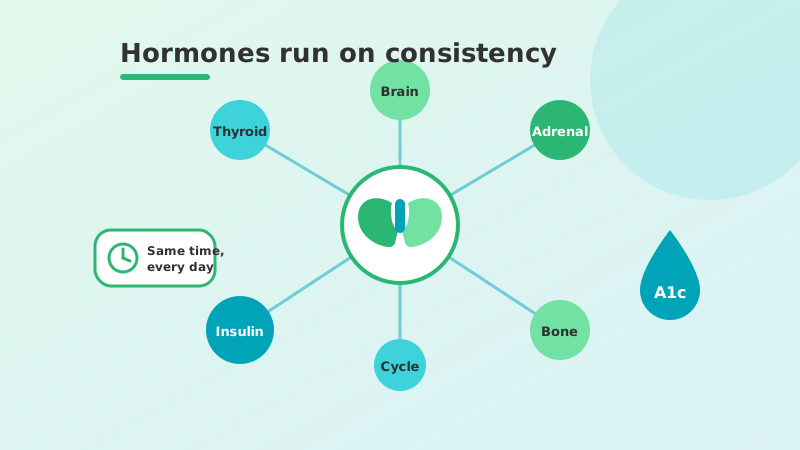
There is a particular frustration that endocrinologists encounter regularly in their clinics. A patient arrives for follow-up. Their thyroid function tests remain abnormal despite three months on levothyroxine. Their HbA1c has barely moved. On paper, they are on the right medication at the right dose. In practice, something is missing — not the prescription, but the consistency behind it.
The endocrine system does not forgive irregularity easily. Unlike some organ systems that tolerate occasional lapses, the hormonal network governing metabolism, blood sugar, thyroid function, and adrenal response operates on delicate feedback loops. When medications designed to support or replace these hormones are taken inconsistently, the consequences are not always immediate — but they are, almost always, cumulative.
The Endocrine System: A Precision Network
The endocrine system is the body's chemical communication network. Hormones — produced in tiny quantities by glands such as the thyroid, pancreas, adrenal glands, and pituitary — travel through the bloodstream and instruct virtually every cell in the body. Blood sugar regulation, energy metabolism, bone strength, reproductive cycles, stress response: all of these depend on hormonal balance maintained within remarkably narrow ranges.
This precision is exactly what makes medication timing and consistency so clinically critical in endocrine disorders. When the gland itself is failing, the medication is the hormone — and giving it irregularly is the physiological equivalent of sending incomplete messages through a system that is already struggling to receive them.
Diabetes: The Loudest Signal Ignored
No endocrine condition illustrates the consequences of medication non-adherence more starkly than type 2 diabetes. It is, by global disease burden, among the most prevalent chronic conditions of our time — and simultaneously among those with the highest rates of treatment non-adherence.
The challenge with type 2 diabetes is not that patients are unaware of its seriousness. Most are. The problem is that poorly controlled diabetes rarely announces itself with immediate, dramatic symptoms. Blood sugar levels may remain chronically elevated for months or years without producing symptoms sharp enough to compel action. The damage, however, is ongoing.
Hyperglycaemia sustained over time injures the microvasculature — the finest blood vessels supplying the kidneys, retina, and peripheral nerves. The clinical consequences of long-term non-adherence in diabetes include diabetic nephropathy (kidney disease progressing toward dialysis), diabetic retinopathy (a leading cause of preventable blindness), and peripheral neuropathy (nerve damage that begins as numbness and can culminate in amputation). These are not hypothetical risks. They represent the real trajectories of patients whose HbA1c remained elevated across years because medication was taken sporadically, doses were skipped on "feeling fine" days, or timing was never consistent.
For patients on insulin, the stakes of inconsistency are even more immediate. Insulin timing is physiologically tied to meals and circadian glucose patterns. Taking a dose late, skipping it, or taking it at irregular intervals does not simply reduce efficacy — it disrupts the metabolic balance in ways that accumulate subtly but persistently.
Research published in Diabetes Care has documented that medication non-adherence in type 2 diabetes is associated with significantly higher rates of hospitalisation, emergency presentations, and long-term complications — and that meaningful improvement in adherence translates directly into measurable reductions in these outcomes. This is not a soft association. It is a dose-response relationship: more consistent medication use, fewer complications.
Thyroid Disease: The Silent Disruption
If diabetes is the most visible of endocrine conditions globally, thyroid disease — particularly hypothyroidism — is arguably the most underestimated in its consequences when inadequately managed. In Bangladesh, thyroid disorders have emerged as a significant public health concern, with hypothyroidism disproportionately affecting women and frequently going undiagnosed or undertreated for extended periods.
Levothyroxine — the synthetic thyroid hormone used to treat hypothyroidism — is one of the most widely prescribed medications in the world. Its pharmacology demands a level of discipline that many patients are never clearly told about.
Levothyroxine must be taken at a consistent time every day, ideally in the morning on an empty stomach, at least 30 to 60 minutes before food or other medications. This is not a general guideline. It is a pharmacokinetic requirement. Calcium-containing foods, iron supplements, coffee, and even high-fibre meals can reduce levothyroxine absorption by 20 to 40 percent. A patient taking their tablet "sometime in the morning" — sometimes with tea, sometimes after breakfast, occasionally forgetting altogether — may believe they are adherent while their thyroid levels remain persistently out of range.
The consequences of inadequately treated hypothyroidism are wide-ranging and significantly impact quality of life: persistent fatigue, weight gain, cognitive slowing, depression, hypercholesterolaemia, and — in women of reproductive age — irregular menstrual cycles and risks during pregnancy. What makes this particularly challenging is that patients often attribute these symptoms to stress, ageing, or lifestyle, rather than recognising them as the downstream effects of inconsistently managed thyroid function.
There is another clinical subtlety worth noting. Because levothyroxine has a long half-life, missing a single dose does not cause the immediate, dramatic symptoms that might reinforce the habit of taking it. The feedback is delayed and diffuse. This absence of an obvious penalty for missing a dose is, paradoxically, one of the strongest drivers of non-adherence in thyroid disease.
Beyond Diabetes and Thyroid: Other Endocrine Conditions That Demand Consistency
Polycystic Ovary Syndrome (PCOS)
PCOS is the most common endocrine disorder in women of reproductive age, and it is increasingly prevalent in Bangladesh and South Asia, partly driven by rising rates of insulin resistance and metabolic syndrome. Many women with PCOS are prescribed metformin — not primarily as a diabetes medication, but to improve insulin sensitivity and regulate menstrual cycles. Irregular use of metformin in this context produces inconsistent hormonal regulation, undermines ovulatory cycles, and reduces the likelihood of treatment success. Combined oral contraceptive pills, when used as part of PCOS management, similarly require daily consistency; missing doses disrupts the hormonal suppression that controls symptoms such as acne, hirsutism, and cycle irregularity.
Adrenal Insufficiency
Primary adrenal insufficiency (Addison's disease) and secondary adrenal insufficiency require daily glucocorticoid replacement — typically hydrocortisone or prednisolone. This is not a condition where missed doses are physiologically trivial. Cortisol plays a fundamental role in maintaining blood pressure, glucose homeostasis, and the stress response. Patients who miss doses during periods of illness, surgery, or physical stress risk an adrenal crisis — a potentially life-threatening emergency characterised by severe hypotension, vomiting, and cardiovascular collapse. In these patients, medication adherence is not simply important for long-term disease control. It is, on certain days, the difference between stability and a medical emergency.
Osteoporosis and Calcium-Vitamin D Supplementation
While osteoporosis sits at the intersection of endocrinology and metabolic bone disease, its pharmacological management demands attention to adherence patterns that differ from most other conditions. Bisphosphonates — the most commonly prescribed class of medications for osteoporosis — are taken weekly or monthly, a dosing schedule designed to simplify adherence. And yet, evidence consistently shows that adherence to bisphosphonate therapy remains poor at the one-year mark, with a significant proportion of patients discontinuing or interrupting treatment within the first year. The clinical consequence is a return toward elevated fracture risk — the very outcome the medication was intended to prevent.
Why Endocrine Patients Struggle With Adherence
Understanding why patients with endocrine disorders find it difficult to maintain consistent medication use requires looking beyond willpower or education.
The absence of immediate symptoms. Endocrine diseases are largely asymptomatic in their early deterioration. When a patient skips their metformin and feels no different the next day, the behavioural reinforcement for adherence is absent. The consequences arrive months or years later, in the form of a blood test result or a complication.
Complex timing requirements. Levothyroxine must be taken at a specific time relative to meals. Insulin must be aligned with food intake. Some medications interact with common foods and supplements. These requirements are clinically essential but rarely communicated with sufficient clarity or reinforced at follow-up.
Multiple medications. Many patients with endocrine disorders take more than one medication — a reality particularly common in type 2 diabetes, where blood pressure, lipid-lowering, and glucose-lowering agents are often prescribed simultaneously. Polypharmacy increases cognitive burden, complicates routines, and significantly raises the risk of missed doses.
Long treatment duration. Hypothyroidism, type 2 diabetes, and adrenal insufficiency are, in most cases, lifelong conditions. Sustaining adherence across years — through illness, travel, personal difficulties, and life changes — is a genuine behavioural challenge, not a reflection of patient character.
Cost and access. In resource-limited settings, out-of-pocket medication costs remain a significant barrier. Patients sometimes ration doses or interrupt treatment not by choice, but by circumstance.
Building Better Adherence: What Actually Works
In the Clinic
The most consistent evidence supports structured patient education delivered at the point of prescription — not just a leaflet, but a genuine explanation of why timing matters, what the consequences of irregularity are, and how the medication works in relation to the patient's own biology. A patient who understands that levothyroxine absorption is compromised by morning coffee is far more likely to manage the timing correctly than one who was simply told to take it "on an empty stomach."
Simplifying regimens where clinically appropriate — consolidating doses, choosing once-daily formulations when available — reduces the cognitive load on patients managing multiple conditions.
Regular monitoring that provides patients with tangible, personalised feedback on their control (HbA1c trends, thyroid function improvement) creates a form of visible reinforcement that motivates continued adherence.
Behavioural Strategies
Habit-stacking — linking medication-taking to a consistent daily anchor such as waking, a specific meal, or toothbrushing — is one of the most practical and evidence-supported behavioural strategies for long-term adherence. The goal is to remove the decision-making burden from each dose and embed it into an automatic routine.
Technology as a Clinical Support Tool
In managing chronic endocrine conditions where timing precision and daily consistency are clinically essential, technology-assisted adherence support has a meaningful role to play. Smart medication management systems — devices that organise medications by dose and time, provide timely alerts, and help patients maintain their schedule — address the single most frequently cited reason for non-adherence: forgetting.
These tools are particularly relevant for patients managing multiple medications at different times, older patients who may have difficulty tracking complex regimens, and those with conditions where timing precision is pharmacologically critical — such as levothyroxine therapy or insulin-based diabetes management.
Kiron, a smart medication adherence system developed by Caretron, represents this category of clinical support tool. Designed to remind patients when to take their medications and to help maintain consistent dosing schedules, it addresses a gap that prescriptions alone cannot fill: the space between knowing what to take and actually taking it, every day, at the right time.
The Clinical Reality
Endocrine disorders are, for the most part, conditions that medicine knows how to manage. The medications exist. The monitoring frameworks exist. The clinical guidelines are well established. What continues to complicate outcomes is the gap between prescription and consistent practice.
A patient with well-controlled hypothyroidism can lead a completely normal life. A patient with well-managed type 2 diabetes can avoid the complications that once made the diagnosis so feared. The treatments work — when they are taken consistently, at the right time, as prescribed.
This is not a simple problem, and it is not a patient failure. It is a human challenge embedded in the complexity of living with a chronic condition across years and decades. Addressing it requires better education, more thoughtful clinical communication, simplified regimens where possible, and, increasingly, practical tools that extend clinical support into the daily lives of patients.
The endocrine system maintains balance through relentless consistency. The medications that support it deserve the same.