
A scene that plays out every week
A 58-year-old man arrives at the kidney clinic for his three-month review. He has had diabetes for years, and it has begun to affect his kidneys. His blood pressure today reads 162 over 94 — uncomfortably high — even though he is on four different blood pressure tablets. The urine test shows more protein leaking through the kidney filters than at the last visit. The blood test shows that his kidneys are filtering waste from the body less efficiently than they were a year ago.
Then the pharmacy record tells the rest of the story. His most important kidney-protecting medication was last refilled four months ago. He insists he "takes everything regularly."
This patient is not unusual. In kidney clinics around the world, he is the rule.
The same picture plays out in the dialysis unit, where blood phosphate stays stubbornly above target despite an adequate prescription of binders. And in the transplant clinic, where an unexplained rise in creatinine in a previously stable transplanted kidney often turns out to have a simpler explanation than rejection — a tacrolimus dose missed during work travel, then "made up" by doubling the next one.
Medication non-adherence is one of the most modifiable, most underestimated, and most consequential problems in kidney care. It is also one of the least systematically measured. The drug that is never quite taken on time slowly outweighs the drug that was prescribed.
What does "adherence" actually mean
The word adherence sounds clinical, but the idea is simple: doing what you and your doctor agreed to do, consistently, over time.
The World Health Organization defines it as the extent to which a person's behaviour matches the recommendations agreed with their healthcare provider. The phrasing is deliberate. Adherence is a partnership, not obedience.
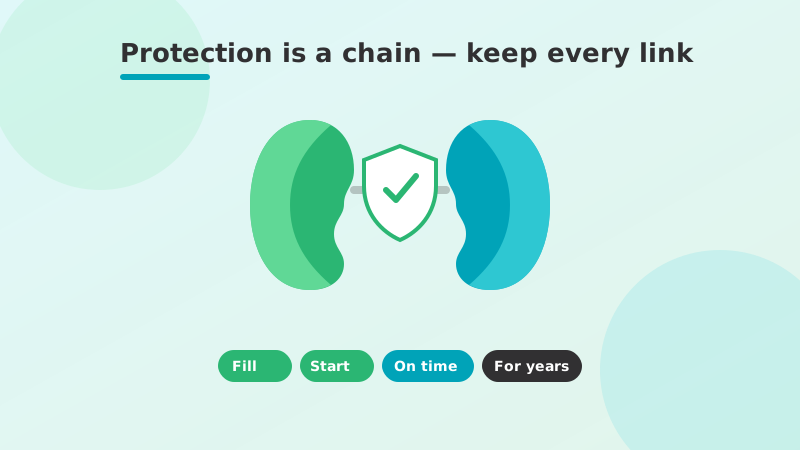
In kidney disease, adherence is not a single act. It is a chain of behaviours: filling the prescription, starting the medication, taking it on time, taking it with food when required, and continuing it for years or decades. A break at any link in this chain produces clinical consequences. Across long-term illnesses, only about half of patients take their medications as prescribed. Kidney disease is no different — and in some respects, worse, because the regimens involved are unusually complex.
The most useful way to think about adherence is this: it is a treatable clinical variable, not a verdict on a patient's character. Treating it as the latter has been a quiet failure of medicine for several decades.
Why kidneys are uniquely vulnerable
Few organs punish poor adherence as efficiently as the kidney. Three things make it singular.
The disease is silent in its early and middle stages. A person with moderate chronic kidney disease usually feels well. There is no chest pain to anchor the prescription to a felt experience. No breathlessness, no obvious symptom that reminds them to take the pill. Without symptoms, the perceived need for a daily kidney-protective tablet weakens — while the side effects, like dry cough or dizziness, remain very much present.
The benefit unfolds on a timescale the patient cannot feel. A blood pressure pill works in hours. Its effect on kidney protection plays out over years. Patients reasonably ask, "Am I getting better?" The honest answer is, "You are getting worse more slowly than you would have." That is a hard sell over a decade.
The kidney patient is rarely on a single drug. Even moderate kidney disease often involves a blood pressure medication, a newer kidney-and-heart-protective drug called an SGLT2 inhibitor, a cholesterol pill, sometimes a water tablet, sometimes phosphate or vitamin D treatments. By the time a patient is on dialysis, the daily pill count often exceeds twelve to nineteen tablets — among the highest in any long-term illness. Adherence drops predictably with every additional medication and every additional dosing time of day. This is not a moral failing. It is a behavioural law that medicine has known about for decades.
What non-adherence costs at each stage
The clinical price of missed doses changes shape across the kidney disease journey. Each stage is worth looking at on its own.
Before dialysis: chronic kidney disease
The most important class of drugs for slowing kidney damage in chronic kidney disease is a group of blood pressure tablets often called ACE inhibitors and ARBs. They protect the kidney in a way no other class does. SGLT2 inhibitors, originally developed for diabetes, do something similar.
The benefit shown in the landmark clinical trials assumes the patient actually takes the drug. Real-world adherence is far below trial-level adherence, which is one reason real-world outcomes consistently fall short of trial outcomes.
Inadequate blood pressure control is the second pathway to kidney damage. High blood pressure is the most common driver of kidney decline globally, and adherence is the single most important determinant of whether a patient's blood pressure ever reaches target. A person who takes three blood pressure pills at 70% adherence is, in pharmacological reality, on far less than three.
Cholesterol-lowering statins, often discontinued in CKD, are one of the few interventions known to reduce heart attacks and strokes in this group. Most CKD patients die of cardiovascular disease, not of dialysis. A single missed statin dose looks small. A two-year cumulative pattern is not.
On hemodialysis
For dialysis patients, the most under-recognised adherence problem hides inside the daily eating routine. Phosphate binders are tablets that must be taken with every meal — not before, not after, but during. They work by trapping the phosphate in food while it is still in the gut, before it can be absorbed into the bloodstream. Timing is everything. A binder taken an hour after a meal does almost nothing.
Imagine being asked to take three to nine of these tablets across every meal and snack of every day, indefinitely. The inevitable outcome is that even when the prescription on paper looks adequate, the actual phosphate level in the blood often stays above target.
This matters more than it sounds. Persistently high phosphate quietly damages blood vessels, weakens bones, throws the parathyroid glands out of balance, and shortens life. The connection between phosphate control and survival is one of the cleanest links in dialysis medicine. Yet adherence here is rarely measured beyond a glance at the pre-dialysis lab number.
Other dialysis pressure points include calcimimetic drugs, blood pressure tablets in patients who still pass urine, and the routine vaccinations these patients depend on. Nothing here is dramatic on a single day. All of it accumulates.
After kidney transplantation
Transplantation is where adherence becomes most unforgiving. The cornerstone medication is tacrolimus — an immunosuppressant that quiets the immune system just enough to keep it from attacking the transplanted kidney.
The drug has a narrow margin. Too little, and the body starts to reject the kidney. Too much, and the drug itself becomes toxic to the kidney it is meant to protect. This narrow margin makes tacrolimus exquisitely sensitive to dosing patterns. A missed dose, a doubled dose, or a dose taken at an unusual hour can push the level outside the safe window for a day or two — long enough, sometimes, to allow a rejection episode that a properly timed dose would have prevented.
A growing body of evidence now points to non-adherence as one of the leading causes of late kidney transplant loss in otherwise stable recipients. The international transplant care guideline (KDIGO) explicitly tells clinicians to assess adherence at every visit. In practice, this rarely happens in any structured way. Most clinicians ask, "Are you taking your medications?" Most patients say, "Yes." Both walk away believing the conversation was useful.
Why people miss doses
The reasons are not mysterious. Most have very little to do with the patient's intent.
Forgetfulness is the most common reason across every long-term illness, including kidney disease. It is not a sign of poor motivation. Working memory is finite, and a multi-drug, multi-time-of-day regimen for several conditions exceeds what most people can track without external help.
Cost drives both the prescription that is never filled and the pills that get stretched, skipped, or substituted without medical advice. Even where insurance covers most of the regimen, dialysis and transplant patients carry one of the highest out-of-pocket pharmacy burdens of any long-term illness.
Side effects matter especially in kidney disease. Water tablets cause inconvenient urinary frequency. Some blood pressure pills cause a persistent dry cough. Phosphate binders cause constipation or nausea. SGLT2 inhibitors increase urinary frequency and the risk of genital infections. Patients quietly stop drugs that cause side effects, and they often do so without telling the doctor. The next consultation then proceeds on the unstated assumption that the medication is still being taken.
Lack of understanding about why a drug is prescribed correlates strongly with non-adherence. Patients often do not know which of their medications protects the kidney, which controls blood pressure, and which manages a complication. A drug whose purpose is unclear feels easier to skip on a busy day.
Quiet psychological resistance is real. Transplant recipients sometimes associate immunosuppressants with the unwelcome reminder of being a "patient" rather than a recovered person. Dialysis patients exhausted by their pill burden ration their effort. CKD patients, shaped by the slow weight of the illness, gradually drift.
These are not patient failures. They are the predictable outputs of a system that asks people with complex lives to follow complex regimens, for a benefit they cannot feel, indefinitely.
Three uncomfortable truths
Beneath the surface data, three quieter realities shape how adherence actually behaves in practice.
The first is white-coat adherence. Patients are noticeably more adherent in the days surrounding a clinic visit than in the months between. Refills jump just before an appointment. Pill organisers fill up. Lab values look better. The clinician sees a partial, rehearsed version of the patient's actual medication-taking life. This is not deception. But it does mean adherence cannot be reliably assessed from clinic data alone.
The second is the provider blind spot. Doctors consistently overestimate their own patients' adherence. Self-report — what most clinics rely on — correlates weakly with what actually happens at home. The most reliable real-world signal comes from pharmacy refill data, which most clinicians do not routinely review.
The third is decision fatigue under polypharmacy. Patients on more than ten medications make small adherence trade-offs every day. The pill most likely to be skipped is the one whose effect is slow, silent, and abstract. Which is, almost always, the kidney-protective one.
What actually works
Improving adherence in kidney disease requires action at three levels at once. No single intervention is reliably effective on its own. Combinations work.
Behavioural and educational
Patients who understand why each of their medications exists are more adherent than those who do not. A short, plain-language explanation of which drug protects the kidney, which controls blood pressure, and which manages a complication makes a measurable difference. Shared decision-making — choosing between equally acceptable regimens together with the patient — turns a passive prescription into a co-owned plan.
The way clinicians ask about adherence matters too. Instead of "Are you taking your medications?" — which almost always gets a "yes" — a more useful question is, "Most people miss doses sometimes. How often does it happen for you?" The phrasing normalises the answer and produces more honest information. Brief validated tools, such as the eight-item Morisky scale, can be folded into a clinic visit without much added time.
Clinical and pharmacological
Simplifying the regimen is the single most consistently effective intervention. Once-daily dosing is associated with substantially better adherence than multiple-dose regimens; each additional daily dose is associated with roughly a 10% drop in adherence. Where clinical equivalence allows, fixed-dose combinations and once-daily formulations should be preferred. Synchronising refill dates across pharmacies removes a hidden cognitive load that patients rarely talk about.
A medication review at every visit — explicitly looking for redundant drugs, deprescribing where appropriate — is a clinical action with measurable adherence consequences. For phosphate binders specifically, aligning the prescription with the patient's actual eating pattern, rather than a generic three-meal assumption, produces better real-world phosphate control.
Technological
This is where the most rapid recent progress has occurred. Electronic reminders, smart pill organisers, refill alerts, and connected medication systems have moved from experimental tools to viable clinical adjuncts. Reviews of randomised data show that adherence interventions which include prompting mechanisms produce meaningfully larger effects than those without.
Smart medication systems — devices that combine compartmentalised storage, scheduled reminders, and real-time intake tracking — fit the kidney patient's situation particularly well. A long-term, multi-drug, multi-time-of-day regimen for a silent disease is the use case these tools were built for. Solutions such as Kiron, an intelligent medication management system designed to support timely dosing and reduce forgetfulness, illustrate the direction of travel. Their value is not in replacing the prescribing decision. It is in closing the gap between prescription and behaviour, where most adherence failures actually live.
Conclusion
The hardest problem in long-term kidney care is not the prescription. It is the seven hundred days between prescriptions, when the patient is alone with a complicated regimen, a silent disease, and a busy life.
Non-adherence in kidney disease is not a sign of weak patients or weak doctors. It is the predictable outcome of a system that asks people with a silent illness to take many medications, on tight timing, for a benefit they cannot feel, for the rest of their lives. Treating adherence as a treatable clinical variable — measuring it honestly, simplifying the regimen around it, and supporting it with both behavioural and technological scaffolding — is now as central to kidney care as adjusting a blood pressure pill or managing a dialysis access.
The dose taken on time, consistently, for years, is the most powerful kidney-protective intervention we have. Most other things we do in kidney medicine either depend on it, or compensate for its absence.